

Substation Transformer
The Substation Transformer Manufacturer!
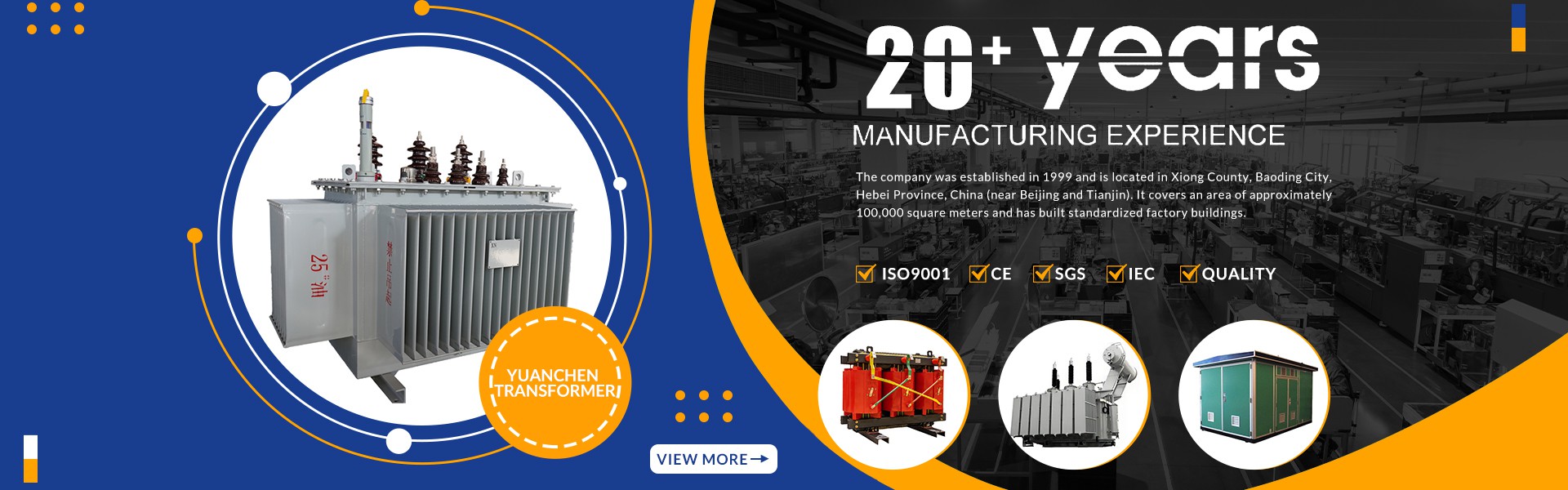
Baoding Yuanchen Transformer Manufacturing Co., Ltd. It has strong technical strength and has formed a series of production and service capabilities from product development and research, manufacturing and processing to after-sales service. The main products include oil immersed power transformers of 35KV and below, dry-type transformers, mobile box type transformers, prepaid control high voltage metering boxes, high and low voltage switchgear, charging piles, and nearly a hundred specifications in six categories. The annual production reaches 5 million KVA.


Our Certifications
Establish a quality assurance system strictly in accordance with the IS09001 model, covering the entire process from procurement to production and service, to ensure that the entire product process is under control. And obtained the IS09001-2015 quality system certification certificate from Hyde International Certification Co., Ltd. in October 2020.
Production Equipment
Core processing equipment, coil winding equipment, insulation treatment equipment, assembly and final assembly equipment, testing and quality inspection equipment.
Sale Service
Suppliers provide technical support to customers online, in addition to offering maintenance plans and repair services to ensure the normal operation of transformers.
Benefits of Substation Transformer for Businesses
Improved Efficiency
Substation transformers can help to improve the overall efficiency of an electrical distribution system. This is because they can convert high-voltage electricity into lower voltages, which can then be used more effectively by businesses. Additionally, substation transformers can also help to regulate the flow of electricity within a system, which can further improve efficiency levels.
Increased Reliability
Another benefit that businesses can enjoy by investing in substation transformer technology is increased reliability. This is because these transformers are designed to operate reliably even under demanding conditions. Additionally, substation transformers are often equipped with features that allow them to self-monitor and diagnose any potential problems, which helps to ensure that they always remain operational.
Enhanced Safety
Another key benefit of substation transformer technology is enhanced safety levels. This is because these transformers are designed with safety in mind and feature several safety-enhancing features. For example, many substation transformers are equipped with overcurrent protection devices that prevent dangerous overloads from occurring. Additionally, these transformers also typically feature enclosures that protect against fire and electrical hazards.
Reduced Maintenance Costs
Finally, businesses can also enjoy reduced maintenance costs when investing in substation transformer technology. This is because the transformers generally require less upkeep and maintenance than other types of transformers. Additionally, their relatively simple design makes them easier to maintain and repair.
Cooling Systems: Dry-Type vs. Oil-Immersed
Cooling systems are integral to the efficient functioning of substation transformers, managing heat dissipation and ensuring operational stability. Dry-type transformers are particularly advantageous in urban environments due to their inherent safety benefits and reduced risk of fire, as they are cooled by air. On the other hand, oil-immersed transformers are favored in high-capacity systems for their superior cooling capabilities, accommodating larger loads effectively. The choice between these cooling methods significantly affects operational stability and the longevity of transformers, ultimately impacting return on investment (ROI) positively.
Protection Devices: Circuit Breakers and Arresters
Protection devices, including circuit breakers and lightning arresters, are essential for safeguarding transformers against electrical faults and atmospheric voltage spikes. Circuit breakers ensure transformers can shut down safely in emergencies, thus preventing damage to the electrical grid. Lightning arresters are indispensable in today's context of increasing severe weather conditions, protecting transformers from surge damages. Regular testing and maintenance of these devices are crucial, as negligence can lead to catastrophic failures and substantial repair costs.

Much does a substation transformer weight
|
(KVA) Rated Power |
(KV) High Voltage |
(V) Low Voltage |
Connection Symbol |
(%) Short Circuit Impendence |
(W) Loss |
Refernence Dimension (W*H*D) mm |
Reference Weight kg |
|
|
(W) No-load Loss |
(W) On-load Loss |
|||||||
|
800 |
4.16 12.00 12.47 13.2 13.8 14.4 23.0 24.94 34.5 34.8 44 or others |
208/120 415/240 480/277 400 600 12000 12470 13200 13800 or others |
Dyn1 Ynyn0 Dyn11 Dd0 Ynd11 or others |
2.7 3.1 4.35 5.75 6.0 |
980 |
9350 |
1060*1500*1780 |
2050 |
|
1000 |
1160 |
11500 |
1085*1570*1800 |
2450 |
||||
|
1250 |
1380 |
13900 |
1160*1610*1890 |
2900 |
||||
|
1600 |
1660 |
16600 |
1190*1630*1950 |
3400 |
||||
|
2000 |
2030 |
18300 |
1260*1700*2090 |
4100 |
||||
|
2500 |
2450 |
19600 |
1150*2150*2250 |
4750 |
||||
|
3000 |
3240 |
26500 |
1900*2600*2150 |
6500 |
||||
|
5000 |
4500 |
27000 |
2500*2210*3180 |
9500 |
||||
|
7500 |
7200 |
32000 |
3660*3100*5100 |
13600 |
||||
|
10000 |
8500 |
35500 |
3830*2640*2216 |
15800 |
||||
We are the largest Business expert
Utility Substation Transformers
These transformers are primarily used by electric power companies to convert high-voltage electricity from power plants into low-voltage electricity suitable for residential, commercial, and industrial use. They typically operate with single-phase or three-phase alternating current and are widely used in both urban and rural distribution systems. Utility transformers are often installed outdoors or in underground facilities to meet various power demands.
Private Industrial Substation Transformers
These transformers supply power to private facilities like factories, hospitals, and schools. They usually receive medium-voltage power from the local utility grid but require dedicated substation transformers to meet specific load requirements. Private industrial transformers are known for their high reliability and large capacity, often installed in more compact spaces.
Underground Substation Transformers
With urbanization increasing, underground substation transformers are becoming the preferred choice in areas with limited space. Due to spatial and environmental constraints, these transformers often require special designs, featuring efficient cooling and insulation systems. Underground substations must also ensure higher safety, durability, and adaptability to elevated temperature and humidity conditions.
Step-Up and Step-Down Substation Transformers
• Step-Up Transformers: These are used to increase low-voltage electricity to a higher voltage suitable for transmission. Step-up transformers are typically located at power plants or far from load centers to minimize energy loss during long-distance transmission.
• Step-Down Transformers: These transformers reduce high-voltage electricity to a lower voltage suitable for consumption. Step-down transformers are commonly placed at the end of distribution networks or near load areas to ensure safe voltage levels for end users.
Oil-Immersed and Dry-Type Substation Transformers
• Oil-Immersed Transformers: These transformers use mineral oil or other insulating oils as cooling and insulation mediums. Due to their simple structure and efficient cooling, oil-immersed transformers are widely used in distribution systems.
• Dry-Type Transformers: These transformers do not use oil and are typically used in environments with high environmental standards, such as indoors, commercial buildings, or hospitals. Without the need for oil as a cooling medium, dry-type transformers are more environmentally friendly and suitable for smaller power loads.
FAQ
As one of the most professional substation transformer manufacturers and suppliers in China, we're featured by quality products and good price. Please rest assured to buy cheap substation transformer for sale here from our factory.
core type power transformer, Core Type Transformer, dry core transformer