

Large Power Transformers
The Large Power Transformers Manufacturer!
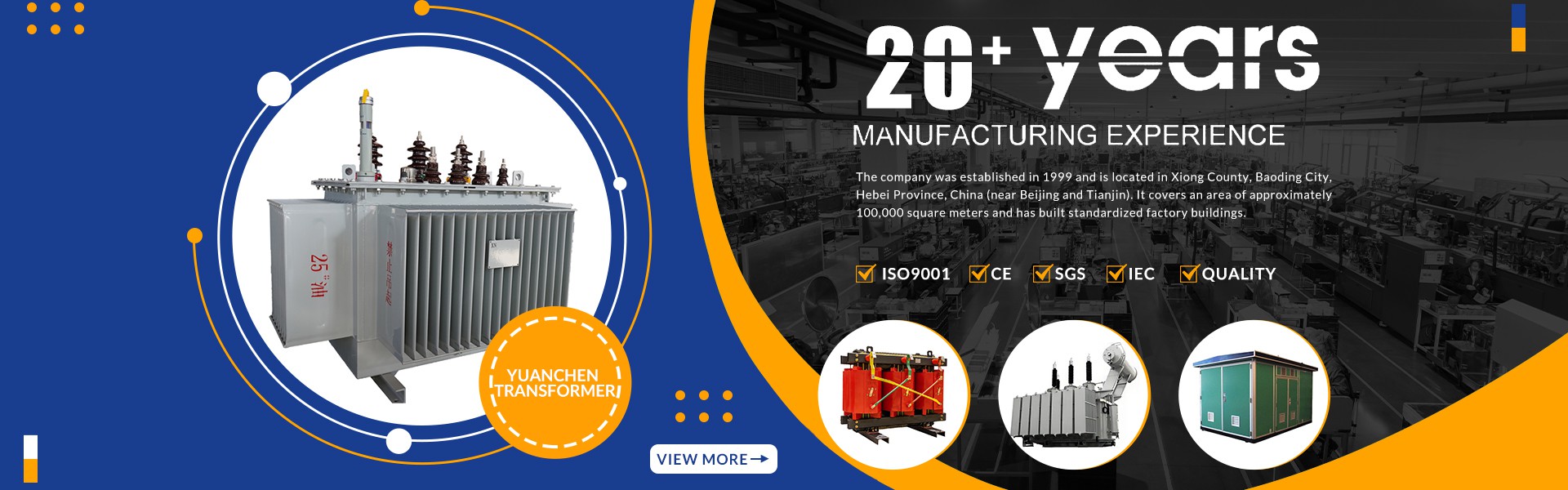
Baoding Yuanchen Transformer Manufacturing Co., Ltd. It has strong technical strength and has formed a series of production and service capabilities from product development and research, manufacturing and processing to after-sales service. The main products include oil immersed power transformers of 35KV and below, dry-type transformers, mobile box type transformers, prepaid control high voltage metering boxes, high and low voltage switchgear, charging piles, and nearly a hundred specifications in six categories. The annual production reaches 5 million KVA.


Our Certifications
Establish a quality assurance system strictly in accordance with the IS09001 model, covering the entire process from procurement to production and service, to ensure that the entire product process is under control. And obtained the IS09001-2015 quality system certification certificate from Hyde International Certification Co., Ltd. in October 2020.
Production Equipment
Core processing equipment, coil winding equipment, insulation treatment equipment, assembly and final assembly equipment, testing and quality inspection equipment.
Sale Service
Suppliers provide technical support to customers online, in addition to offering maintenance plans and repair services to ensure the normal operation of transformers.
Advantages of Power Transformers
Voltage Stability
Power transformers regulate voltage, ensuring a stable and consistent power supply for efficient operation.
Enhanced Transmission Efficiency
Step-up transformers reduce energy losses during long-distance transmission, optimizing grid performance.
Isolation for Safety
Transformers provide electrical isolation, minimizing the risk of shocks and enhancing overall system safety.
Load Adaptability
As the leading power transformer manufacturer, Our transformers match power sources to loads, meeting diverse requirements for industrial, commercial, and residential applications.
Improved Power Quality
Transformers regulate voltage, contributing to a more stable power supply and reducing the risk of equipment damage.
Versatile Applications
With various types available, our power transformer addresses a wide range of energy needs across industries efficiently.
Power transformers come in a range of voltage levels, from medium to extra-high voltage, based on the specific needs of the power system they serve.
36kV ~ 750kV, up to 1,000MVA natural ester oil-filled power transformers. For high-capacity, long-distance transmission lines, often spanning countries or continents for efficient power delivery.
36kV ~ 1000kV, up to 1,200MVA mineral oil-filled power transformers. For ultra-high capacity, ideal for power generation plants, substations, industrial facilities and renewable energy installations.
Power transformers are necessary for the efficient and safe transmission of electricity worldwide. Their ability to step up or step down voltage enables long-distance power delivery and ensures that electrical power reaches end users at appropriate levels. Understanding their operation, applications and specifications is essential for professionals in the energy sector.

Common Uses Of Electric Transformers
Battery Charging
Battery charging systems typically involve a transformer, a bridge rectifier, and an ammeter. The transformer reduces the voltage, while the bridge rectifier converts the AC output of the transformer into DC current. Directly connecting a transformer to a battery is not feasible because the transformer provides current that is unsuitable for battery charging. The use of a rectifier simplifies this process by ensuring the current is appropriately converted for the battery.
Steel Production
The effectiveness of steel production relies heavily on a stable and reliable power supply. Steel manufacturing involves specialized processes that demand various forms of power conversion. Consistent voltage regulation is crucial during transformer operation under load, making it a key requirement for efficient steel production.
Electrochemical Manufacturing
In chemical processing, transformers are used to power electrolysis. During the electroplating of metals like copper, zinc, or aluminum, transformers regulate the electrical current necessary for the chemical reaction, allowing precise control over the current in the process. The system must maintain a stable temperature, provide electrical insulation, and operate effectively in corrosive environments. Rectifiers are used to manage periodic unidirectional pulses of current that exceed the charging source.
Steel Manufacturing
Steel manufacturing involves various processes such as melting, welding, molding, and cooling. Melting and welding require substantial current, while cooling involves lower current levels. High voltage transformers are essential for managing current fluctuations throughout these processes. Step-up and step-down transformers are strategically used in different parts of the circuit to achieve the necessary current levels for each stage of production.
Electrolysis
Electrolysis is a technique employed to divide both homogeneous and heterogeneous materials by decomposing their ions into basic elements. This method involves applying an electric current to induce a chemical reaction. For the process to work effectively, the current must be steady and is managed through an electrical transformer.
Audio
Audio transformers are integral components in microphones, speakers, and amplifiers, engineered to handle signals within the audible spectrum, typically from 20 Hz to 20 KHz. They play a crucial role in filtering out extraneous noise, ensuring that audio devices deliver crisp and precise sound quality. Their application has significantly improved audio clarity in recordings, films, and live events.
Coolant
Air-dried transformers produce a cooling effect that helps maintain freshness in refrigerators. Beyond this cooling function, these electric transformers also manage current flow to prevent surges and voltage irregularities, ensuring the safe operation of refrigeration systems.
Air Conditioners
In air conditioning systems, transformers adjust the voltage from the circuit board to the required level, enabling simultaneous operation of the air conditioner and fan. Electric transformers play a crucial role in improving appliance performance, boosting efficiency, and reducing energy consumption.
Components of Electric Transformers
Bushings
Transformer bushings are insulated components that enable electricity to pass through the tank wall of a transformer without direct contact. They connect the transformer to the power source on the high-voltage side and to the load on the low-voltage side, ensuring safe and efficient electrical transmission.
Core & Coils
The core and coils form the essential parts of a transformer where the induction process occurs. When electricity flows into the transformer, the coils determine how the voltage is transformed. These coils, wrapped around the core, can be made from aluminum or copper, and are crucial in managing the voltage conversion.
Load Break Switches
Load break switches (LBOR switches) are special rotary switches that allow electrical workers to manually disconnect the transformer from the power grid. These switches can be operated even when the transformer is under load, de-energizing the core and coils for safe maintenance and operation.
Fuses
Transformer fuses play a critical role in safeguarding the electrical system against potential issues within the transformer or downstream equipment. When subjected to high currents or excessive heat, a thin wire known as an “element” melts, interrupting the flow of electricity and isolating the transformer from the power grid.
Voltage Adjustment Taps
Voltage adjustment taps in transformers ensure the maintenance of the correct secondary voltage, compensating for variations in primary voltage levels. By rotating the tap changer, segments of the primary windings are adjusted, modifying the ratio of primary to secondary windings and regulating the primary voltage.
Fluid
Transformer oil or fluid serves as a vital cooling agent to dissipate heat generated during transformer operation. Stored in a specialized tank, the fluid circulates through channels between the transformer windings, functioning as both an insulator and coolant. It is exclusive to liquid-filled transformers.
Gauges
Transformer gauges are instrumental in monitoring various operational parameters, such as oil level, temperature, and tank pressure. In larger transformers, monitoring systems may offer more comprehensive and sophisticated monitoring capabilities to ensure optimal performance and safety.
Benefits Of Using A Three-Phase Transformer
Efficiency
Manages high-load power with less energy loss.
01
Cost-effective
Lowers the cost of installation and maintenance in comparison with three-phase single-phase transformers.
02
Space-saving
Compact design takes up smaller space for industrial installations.
03
Reliability
Provides a steady power supply, which reduces the possibility of operating downtime.
04
Reduced Transmission Losses
Facilitates effective power transmission over long distances.
05
Insulating oil/gas: Used as an insulating and cooling medium.
Windings: Made of copper or aluminum and insulated properly.
Core: Made of high-grade silicon-coated steel laminations to reduce eddy current losses.
Conservator tank: Houses the insulating oil and maintains the required oil level.
Breather: Allows air in/out and protects from pressure variations.
Cooling system: Can be oil, air, or forced water-cooled based on power rating.
Bushings: Insulated entries for high voltage bushing leads.
On load tap changer: Helps regulate the output voltage.
Temperature sensors: Monitors hot-spot temperature of winding.

Standard Sizes Of 3-Phase Transformers
Low Power transformers
These types of power transformers typically have 5 kVA or 10 kVA and 500 kVA ratings. They are frequently used in light commercial, manufacturing, and home environments.
Medium Power Transformers
These types of transformers have kVA ratings that commonly vary from 500 kVA to 10 MVA (for example, 1 MVA, 2 MVA). They have a frequent place in power distribution systems, medium-sized retail establishments, and applications in the industry.
High Power Transformers
These include transformer sizes with high power and have kVA ratings from 10 MVA, 20 MVA, 25 MVA, or even higher. Large manufacturing facilities, nuclear plants, substations that operate, and utility transmission lines are common places to find these kinds of transformers in use.
Three-phase transformer configuration
Delta-Delta (D/D)
In a delta transformer (designated D/D), both the primary and secondary windings are connected in a delta configuration. This configuration has several advantages. If one of the three coils malfunctions or fails, the remaining two undamaged coils can still provide three-phase power at approximately two-thirds of the original transformer output.
Star-Star (Y/Y)
Of the four common three-phase transformer configurations, the Y/Y configuration is the most cost-effective choice and provides seamless power transfer with no phase shift between the primary and secondary windings. Having a grounded (neutral) wire on both the primary and secondary sides provides versatility to deliver power to both three-phase and single-phase loads.
Delta-Star (D/Y)
The primary delta and secondary star (D/Y) configuration stands out for its ability to provide a three-wire balanced load to a power generation facility, seamlessly adapting to a variety of applications. This configuration is commonly used to power commercial, industrial, and high-density residential areas.
Star-Delta (Y/D)
With a high voltage input, the voltage on a single coil is reduced by a factor of √3, which reduces the number of winding turns and insulation. This design can be used as a step-down transformer, mainly at the end of a transmission line. It also includes a ground wire (neutral) on the power supply side.
Types Of Three Phase Transformer
Three Phase Core Type Transformer
In a three-phase core type transformer, the magnetic core has three limbs, and each limb contains both the primary and secondary windings for one phase. The limbs are connected at the top and bottom by yokes. This construction allows the magnetic flux of the three phases to share common return paths through the outer limbs, making it a common and relatively straightforward design for medium to high voltage applications.
Three Phase Dry Type Transformer
Three-phase dry type transformers do not use liquid like oil for cooling and insulation. Instead, the windings are insulated using solid materials such as resin or varnish, and cooling is achieved through natural convection or forced air. They are typically used in indoor environments or where fire safety is a critical concern, such as in buildings, hospitals, and substations, as they pose less environmental risk and are fire-resistant.
Three Phase Shell Type Transformer
The three-phase shell type transformer has a core that surrounds most of the windings. The windings are placed on the central limb, and the core provides a protective shell around them. This construction offers better mechanical protection for the windings and superior cooling characteristics due to the larger surface area of the core exposed to the cooling medium. Shell type transformers are often favored for their robustness and efficiency in certain power applications.

Applications of 3 phase transformer
The applications of 3 phase isolation transformers are so many. Let’s take a look at a few of them to get a better understanding of their importance.
Since, a three phase transformer can further exempt any number of high-frequency noise, as well as pulse interference from the coupling of the one phase transformers. These are generally used with precision machine tools.
In addition to this, all three phase transformers are widely used in industries, mining, factories, production companies, textile, printing, packaging, airports, telecommunications, malls, multistory apartments, office equipment, and many more.
All the transmissions, as well as the distribution of the tunnels and equipment are secured to confirm the standard voltage.
In addition to providing all the benefits of three phase transformers, they are also great at offering the benefits of one phase transformers. This makes the range of the benefits of the three phase auto transformer wider.
FAQ
As one of the most professional large power transformers manufacturers and suppliers in China, we're featured by quality products and good price. Please rest assured to buy cheap large power transformers for sale here from our factory.
220 kva transformer, high voltage low power transformer, Unit Substation Transformer