

Power Transformer
The Power Transformer Manufacturer!
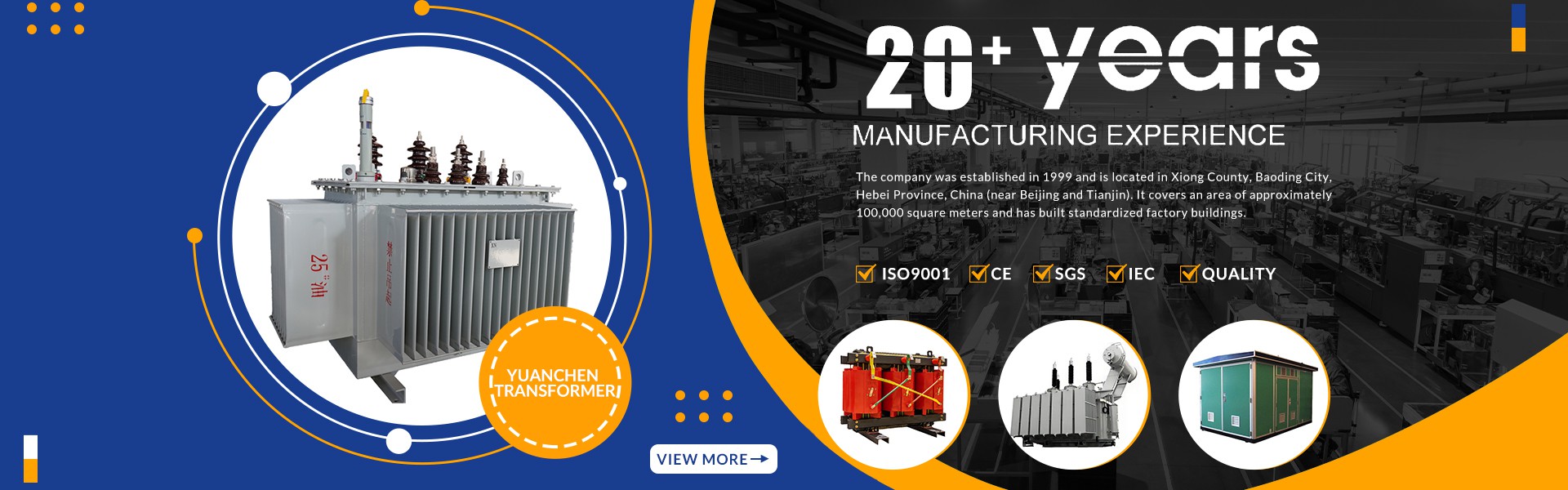
Baoding Yuanchen Transformer Manufacturing Co., Ltd. It has strong technical strength and has formed a series of production and service capabilities from product development and research, manufacturing and processing to after-sales service. The main products include oil immersed power transformers of 35KV and below, dry-type transformers, mobile box type transformers, prepaid control high voltage metering boxes, high and low voltage switchgear, charging piles, and nearly a hundred specifications in six categories. The annual production reaches 5 million KVA.


Our Certifications
Establish a quality assurance system strictly in accordance with the IS09001 model, covering the entire process from procurement to production and service, to ensure that the entire product process is under control. And obtained the IS09001-2015 quality system certification certificate from Hyde International Certification Co., Ltd. in October 2020.
Production Equipment
Core processing equipment, coil winding equipment, insulation treatment equipment, assembly and final assembly equipment, testing and quality inspection equipment.
Sale Service
Suppliers provide technical support to customers online, in addition to offering maintenance plans and repair services to ensure the normal operation of transformers.
Benefits of Power Transformers
Energy efficiency
Transformers are designed to be power-efficient, which helps reduce power losses and save energy.
01
Increased power quality
Transformers help improve power quality by providing power at a safe and consistent voltage level.
02
Improved safety
Transformers provide electrical isolation between power sources and power loads, which helps increase safety.
03
Increased power capacity
Transformers can increase the power capacity of power systems, which helps power more loads.
04
Cost savings
Transformers are cost-effective power solutions and can help reduce power costs in power distribution systems.
05
Application of Power Transformer
Voltage Transformation: Power transformers change or adjust the voltage from high to low or vice versa, making it suitable for various stages of power distribution and utilization.
Voltage Regulation: Transformers help regulate and stabilize voltage levels within the system, ensuring that all connected devices receive the correct, consistent voltage for optimal operation.
Energy Transmission: Power transformers can help in transmitting electricity over long distances efficiently. High voltage levels are used for long-distance transmission to reduce energy loss. The transformers can step up the voltage for transmission and step it down for distribution.
Energy Distribution: These devices are critical to distributing electrical power to end-users. After long-distance transmission, power transformers lower the voltage to a safer level for local distribution networks, making it more easily usable for homes and businesses.
Substation and Grid Operation: Power transformers manage and control electrical power within substations, adjusting voltage levels to balance the supply and demand of electricity across the grid and ensuring stable operation.
Load Balancing: Transformers help to evenly distribute electrical loads across different circuits, preventing overloading and enhancing the efficiency of the electrical system.
Safety Grounding: Isolation transformers can improve safety in electrical systems by separating different parts of the system and grounding the electrical equipment, protecting against electrical shocks and faults.
Power Quality Improvement: Transformers can filter out electrical noise and harmonics, enhancing the overall quality of the electrical power supplied to sensitive equipment.
Facilitating Renewable Energy Integration: Transformers help with bringing renewable energy sources like solar and wind into the grid. Voltage adjustments help these systems match the grid's requirements and enable efficient, stable integration.
Other Specialized Applications: Specialized transformers can cater to specific industrial and commercial needs — such as those for medical equipment or manufacturing processes — to ensure devices are receiving the precise voltage and current they require.
Copper Loss
Copper losses, also known as resistive or I²R losses, occur due to the electrical resistance in the windings as current flows through them. The resistance of the winding material, which affects these losses, depends on factors such as the material's length, cross-sectional area, nature, and temperature. The amount of current flowing through the windings also impacts copper losses. These losses are quantified using the formula I²R.
Hysteresis Loss
Hysteresis losses arise from the friction experienced by the ferromagnetic molecules in the core during the magnetization and demagnetization processes. As the magnetizing force alternates between forward and reverse directions, internal friction generates heat within the transformer.
Eddy Current Loss
Eddy currents are generated in the core's cross-section due to fluctuating magnetic fields. To minimize these losses, transformer cores are constructed from thin, laminated metal sheets. Each lamina is insulated with a special coating, which reduces the path available for eddy currents and limits their flow.
Flux Loss
Flux losses occur when some magnetic flux lines from the primary winding bypass the secondary winding and flow through the air instead. This can happen due to magnetic saturation of the core, where the core is unable to accommodate additional flux lines. Additionally, the difference in reluctance between the air and the core can contribute to these losses.

Types of Electric Transformers
Iron Core Transformers
Iron core transformers are one of the most efficient and widely used transformer types in the electrical industry. They utilize multiple laminated iron plates, often composed of high-grade silicon steel, known for their superior magnetic properties and low core losses. This construction minimizes eddy current losses and hysteresis, improving performance in power transmission and electrical distribution. These transformers are commonly implemented in power plants, substations, and heavy-duty industrial systems where maximum energy transfer and efficiency are required.
Isolation Transformers
All electric transformers utilize electromagnetic induction to transfer electricity between circuits without direct conductive connection, but isolation transformers are specifically engineered to separate the powered device from the main power source. This electrical isolation is critical for protecting sensitive equipment, enhancing safety, and suppressing electrical noise. Isolation transformers are widely used in uninterruptible power supplies (UPS), robotics, test and measurement equipment, medical devices, audio equipment, industrial control systems, and data communication networks. Their ability to provide galvanic isolation makes them essential in applications that require transient voltage suppression, reduced risk of electric shock, and elimination of ground loops.
Ferrite Core Transformers
Ferrite core transformers are designed for high-frequency and switch mode power supply (SMPS) applications. The ferrite core, composed of ceramic materials with high magnetic permeability, results in low core losses at high frequencies, making these transformers ideal for use in power electronics, radio frequency circuits, and compact electrical devices. Their E-type or toroidal configurations can be customized to support a wide range of voltages and currents, including use in inverters, LED drivers, and telecommunications. Ferrite core transformers ensure energy efficiency and minimal electromagnetic interference (EMI) in modern electronic applications.
Step Up Transformers
Step up transformers are critical in electrical power transmission and distribution. They convert low voltage (LV) to high voltage (HV) with corresponding lower current (amperage) and reduced I2R (resistive) losses, enabling efficient long-distance power delivery from generating stations to substations. This voltage transformation relies on a core assembly with two or more sets of copper windings—the secondary coil always contains more turns than the primary coil to “step up” the voltage. In specialized applications, tertiary windings are added for increased flexibility and voltage control.
High Voltage Transformers
The voltage level in a power transmission line determines capacity and safety standards for grid operations. High voltage transformers adjust and manage voltage in high voltage circuits, handling voltages from 600V to 5000V and beyond. These units are key components in power substations, electrical distribution systems, scientific instrumentation, X-ray equipment, and industrial electrostatic applications. High voltage transformers provide metering, isolation, and surge protection while enabling safe operation of high energy equipment and large-scale infrastructure.
Toroidal Core Transformers
Toroidal core transformers feature a ring or donut-shaped magnetic core, which significantly reduces electromagnetic interference and stray induction leakage by generating high inductance. Their short windings and compact size lead to lighter weights compared to similarly rated conventional transformers. The symmetrical construction enhances magnetic flux distribution, supporting high efficiency and quiet performance in sensitive electronics, medical devices, audio amplifiers, and renewable energy inverters. Although manufacturing is more intricate, their benefits in space-saving and energy conservation make them a preferred choice for high-performance, noise-sensitive applications.
FAQ
As one of the most professional power transformer manufacturers and suppliers in China, we're featured by quality products and good price. Please rest assured to buy cheap power transformer for sale here from our factory.
electric transformer, transformers