

Single Phase Power Transformer
The Single Phase Power Transformer Manufacturer!
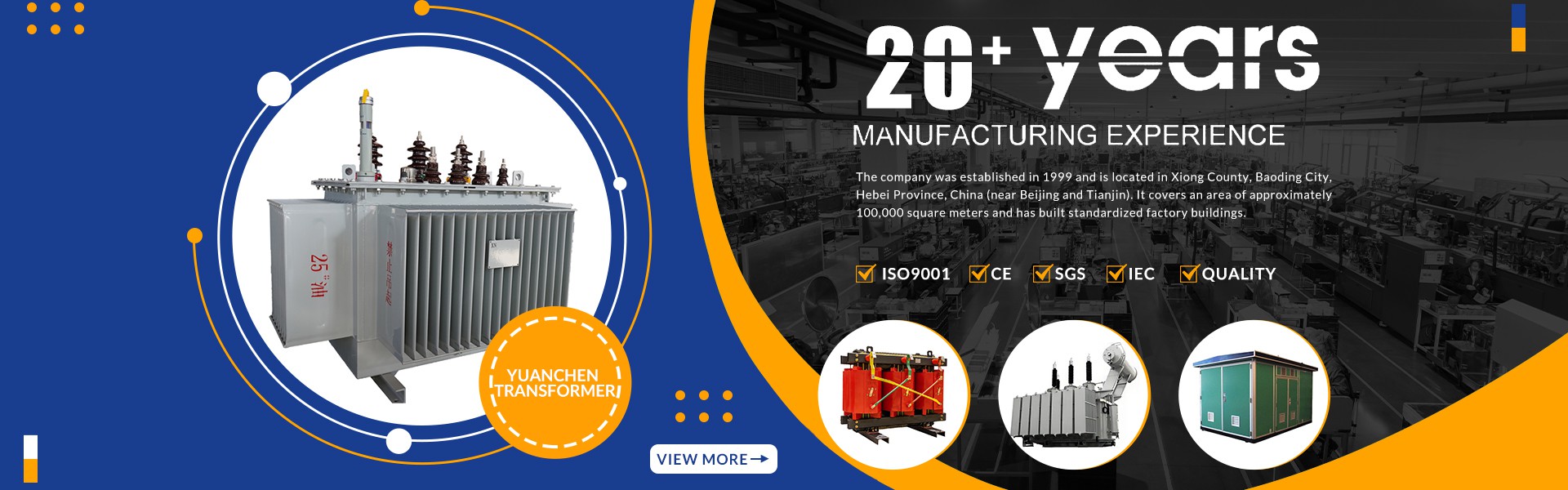
Baoding Yuanchen Transformer Manufacturing Co., Ltd. It has strong technical strength and has formed a series of production and service capabilities from product development and research, manufacturing and processing to after-sales service. The main products include oil immersed power transformers of 35KV and below, dry-type transformers, mobile box type transformers, prepaid control high voltage metering boxes, high and low voltage switchgear, charging piles, and nearly a hundred specifications in six categories. The annual production reaches 5 million KVA.


Our Certifications
Establish a quality assurance system strictly in accordance with the IS09001 model, covering the entire process from procurement to production and service, to ensure that the entire product process is under control. And obtained the IS09001-2015 quality system certification certificate from Hyde International Certification Co., Ltd. in October 2020.
Production Equipment
Core processing equipment, coil winding equipment, insulation treatment equipment, assembly and final assembly equipment, testing and quality inspection equipment.
Sale Service
Suppliers provide technical support to customers online, in addition to offering maintenance plans and repair services to ensure the normal operation of transformers.
Advantages of single phase transformer
Use less material
A single-phase transformer of the same capacity uses 20% less iron than a three-phase transformer. Especially when the wound iron core structure is adopted, the no-load loss of the transformer can be reduced by more than 15%, which will reduce the manufacturing cost and operating cost of the single-phase transformer at the same time, so as to obtain the best life cycle cost.
01
Low line investment
Using a single-phase power supply system in the power grid can save 33% to 63% of wires. Calculated by economic current density, it can save 42% of wire weight. Calculated by mechanical strength, it can reduce wire consumption by 66%. Therefore, the construction investment of the entire transmission line can be reduced. This is very meaningful in terms of street lighting and residential electricity consumption in rural and urban areas with vast areas.
02
Conducive to modern production
Due to its simple structure, single-phase transformers are suitable for large-scale modern production, which is conducive to improving product quality and efficiency.
03
Low installation requirements
The single-phase transformer is light in weight and can be flexibly installed on the pole for use, which is convenient for going deep into the load center, reducing power supply nearby, and improving the quality of power supply. Generally, single-phase transformers supply power in a small range, and the fault spread is small, which is conducive to improving the reliability of power supply.
04
Flexible use
Because single-phase transformers are light in weight and easy to install and maintain, they can be used in single-phase or three-phase transformers.
05
Isolation: Isolation is necessary to protect the transformer windings from the core. Isolation is achieved by using insulating materials like glass, mica, varnish, etc.
Core: The core of a transformer is made of iron or steel. It provides a path for the magnetic flux.
Winding: Winding is the coil of wire wound around the transformer core. It carries the current flowing through the transformer.
Primary windings are the ones connected to the AC power source on the transformer. An AC voltage applied to the primary winding produces a magnetic field.
The secondary winding is the one connected to the load on the transformer. When an AC voltage is applied to the primary winding, a voltage is induced in the secondary winding.

Load Test On Single Phase Transformer
A load test is conducted by applying rated voltage and load to a single-phase transformer to determine its voltage regulation and efficiency under actual working conditions. This test helps evaluate how the transformer performs when supplying power to a real load, giving insights into output voltage stability and energy loss. It also provides valuable data to calculate full-load efficiency.
Mounting a Single Phase Transformer
Chassis: Integral components enable the device to be set via fasteners.
Chip: Commonly constructed with thin-film technology, these devices are incorporated into integrated networks and are always used as isolators.
Dish/disk: Toroidal core types can be mounted with hardware that consists of a bolt within the middle of the torus.
H-frame: A mounting form that mitigates the influences of the shock and vibration.
Modular jack: Typically, a modular junction with a built-in transformer.
Pad: The transformer is located on a structural basis, such as substation transformers installed on a concrete pad.
PC/PCB: Also introduced as board-mount types, these transformers transmit voltage between two networks for circuit board cases. They include core, windings, casing, a mounting method (surface mount or through-hole), and connection terminals. Some PCB types are ICs constructed via semiconductor processing.
Pole: These ubiquitous transformers installed on roadside utility poles step down the input from localized transmission rating to the residential- and commercial-suitable voltages.
Skid/Trailer: Massive transformers can be simply relocated to meet changing electrical requirements. They incorporate non-permanent increases in local electrical needs.
Commercial Buildings
The supply of electricity runs through lighting systems along with small equipment within buildings.
Industries
Control circuits along with small-scale machines in small industries operate using single-phase transformers.
Residential Use
The step-down process reduces 230V to 110V power and its reverse operation is also feasible.
Home appliances with televisions and refrigerators among them utilize transformers.
Rural Electrification
The rural areas that do not receive three-phase power supply need transformer solutions.
Battery Chargers
A transformer decreases voltage while it charges electrical batteries.
Renewable Energy Systems
The conversion of voltage in solar and wind energy systems happens with the use of transformers.
HVAC Systems
Heating ventilation and air conditioning systems implement these transformers for operational purposes.
FAQ
As one of the most professional single phase power transformer manufacturers and suppliers in China, we're featured by quality products and good price. Please rest assured to buy cheap single phase power transformer for sale here from our factory.
balanced power transformer, single phase buck boost transformer, single phase power transformer