

Hey there! As a supplier of Ac Power Transformers, I often get asked about how to calculate the voltage regulation of these transformers. It's a crucial aspect, especially for those who rely on a stable power supply. So, let's dive right into it!
First off, what exactly is voltage regulation? Well, it's a measure of how well a transformer can maintain a constant output voltage under varying load conditions. In simpler terms, when you've got different amounts of electrical equipment drawing power from the transformer, you want the output voltage to stay as close as possible to the rated voltage.
To calculate the voltage regulation of an AC power transformer, we need to understand a few key terms. We've got the no - load voltage ((V_{NL})) and the full - load voltage ((V_{FL})). The no - load voltage is the voltage at the secondary winding of the transformer when there's no load connected to it. That means no electrical devices are drawing power from the transformer. On the other hand, the full - load voltage is the voltage at the secondary winding when the transformer is supplying power to its maximum rated load.
The formula for voltage regulation ((VR)) is given by:
[VR=\frac{V_{NL}-V_{FL}}{V_{FL}}\times100%]
Let's break this down a bit. The numerator (V_{NL}-V_{FL}) represents the change in voltage from the no - load condition to the full - load condition. By dividing this change by the full - load voltage and multiplying by 100%, we get the voltage regulation as a percentage.
For example, let's say we have a transformer with a no - load voltage of 240 volts and a full - load voltage of 230 volts. Using the formula:
[VR=\frac{240 - 230}{230}\times100%=\frac{10}{230}\times100%\approx4.35%]
This means that the voltage at the secondary winding of the transformer drops by about 4.35% when it goes from the no - load condition to the full - load condition.
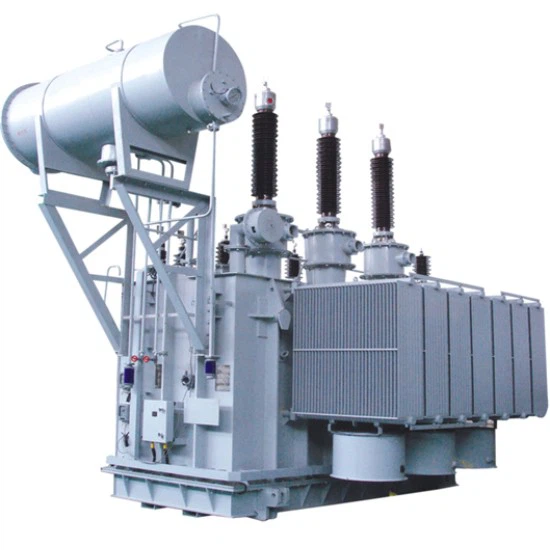

Now, why is voltage regulation so important? Well, many electrical devices are designed to operate within a specific voltage range. If the voltage supplied to these devices fluctuates too much, it can cause problems. For instance, if the voltage is too low, motors may run slower than normal, lights may be dimmer, and electronic devices may malfunction. On the other hand, if the voltage is too high, it can damage the insulation of wires, overheat components, and even cause a fire hazard.
As a supplier of Ac Power Transformer, we understand the importance of providing transformers with good voltage regulation. That's why we use high - quality materials and advanced manufacturing techniques to ensure that our transformers can maintain a stable output voltage under different load conditions.
There are a few factors that can affect the voltage regulation of a transformer. One of the main factors is the resistance and reactance of the transformer windings. The resistance of the windings causes a voltage drop due to the flow of current, and the reactance (both inductive and capacitive) also affects the voltage. Another factor is the load power factor. A low power factor load can cause a larger voltage drop compared to a high power factor load.
To improve the voltage regulation of a transformer, we can use techniques such as adding tap changers. Tap changers allow us to adjust the turns ratio of the transformer, which in turn can help to compensate for the voltage drop. We can also use power factor correction devices to improve the power factor of the load, reducing the voltage drop.
When it comes to choosing a transformer, it's important to consider the voltage regulation requirements of your application. If you've got sensitive electronic equipment that requires a very stable voltage, you'll need a transformer with a low voltage regulation. On the other hand, if you're powering less sensitive equipment, a transformer with a slightly higher voltage regulation may be acceptable.
At our company, we offer a wide range of High Voltage Power Transformer and Custom Power Transformers to meet different customer needs. Whether you need a transformer for a small industrial application or a large power grid, we've got you covered.
If you're in the market for an AC power transformer and want to learn more about voltage regulation or any other aspects of our products, don't hesitate to reach out. We're here to help you make the right choice for your power supply needs.
References:
- Electrical Power Systems by J. R. Lucas
- Transformer Engineering: Design, Technology, and Diagnostics by George Karady and G. Venkata